
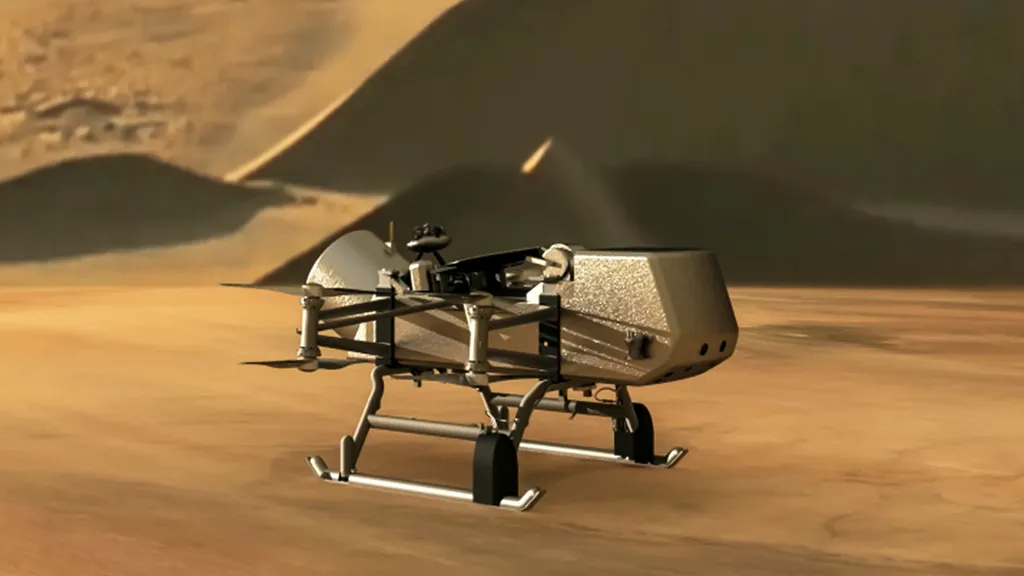
 Image Credit: NASA
 NASA’s New "Apparent Mass" Math: How Dragonfly’s Parachute Will Stay on Course
When a spacecraft lands on a planet, it’s not just a simple “drop-through-the-air” story. Think of a skydiver: the parachute feels the wind, the body twists, and the whole system behaves like a giant, flexible pendulum. For NASA’s upcoming Dragonfly mission to Titan, the planet’s thick atmosphere makes the math even trickier. One key to getting the math right was a fresh, explicit way to calculate the “apparent mass” of a lifting body such as a parachute or submersible in a way that can be easily incorporated into standard dynamics simulations. These new capabilities have been validated within the kdFlex simulation software. We will be presenting this work in upcoming papers at AIAA Aviation and AIAA Aerodynamic Decelerator Systems Technology Conference in June; for a sneak preview, the abstracts are linked below.
The details of this work are available in the NESC TI-24-02037 technical report. This research was sponsored by the NASA Engineering and Safety Center (NESC), and was a collaboration between teams at Jet Propulsion Laboratory, NASA Langley Research Center, Dragonfly Parachute Decelerator System and Flight Mechanics, and Karana Dynamics. The authors are especially grateful to Heather Koehler of the NASA Engineering Safety Center for leading and supporting this effort.