
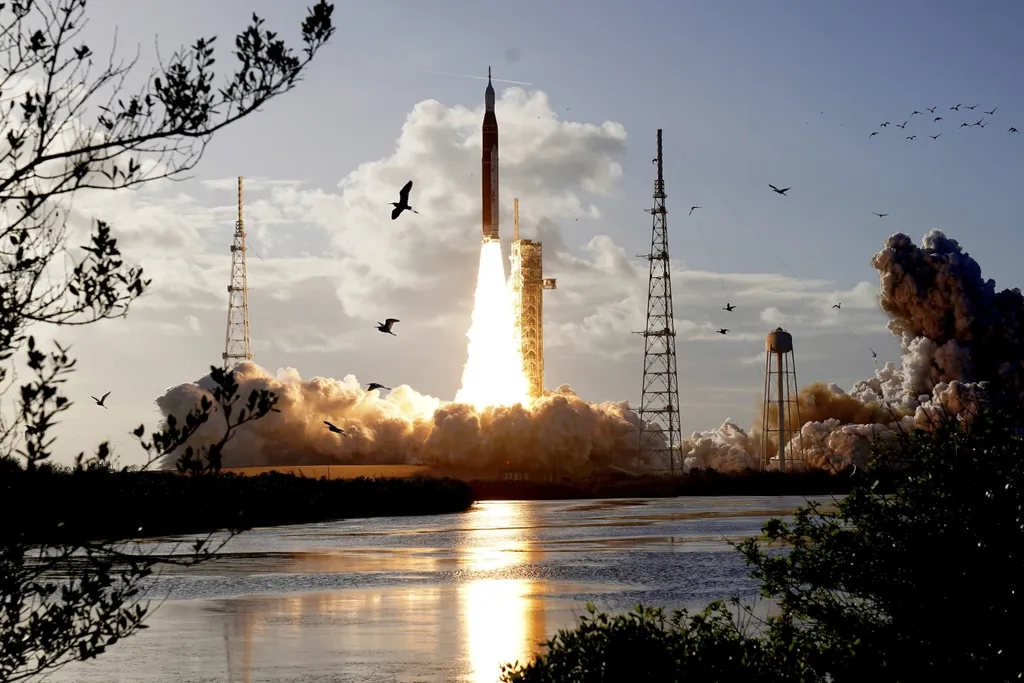
 Image Credit: Chris O'Meara - AP
 A Small Tool, Big Impact: SOA’s Role in the Artemis II Mission
Did you know that the Spatial Operator Algebra framework (the “magic” behind kdFlex) is contributing to the Artemis II mission?
Untangling the mathematics
At its heart, SOA1 is a mathematical toolbox that transforms the complex equations of motion for a spacecraft or robot into a tidy, “minimal-coordinate” form. Think of it like turning a tangled knot of wires into a straight, single cable. That’s why NASA’s Jet Propulsion Laboratory (JPL) used SOA to build the DARTS simulation suite, which has supported multiple NASA Mars lander missions and robotics projects.
A partnership that grew into a trusted toolkit
More than a decade ago, the Karana team (then at JPL) initiated a collaboration with NASA’s Johnson Space Center (JSC). After an extensive evaluation process, JSC’s Flight Operations Directorate (FOD) selected the DARTS toolkit for their in-house flight dynamics simulation development; this effort eventually became the JSC COMPASS project. Starting with support for the International Space Station, COMPASS expanded to support a series of NASA missions including Ascent Abort 2, Artemis I, and now Artemis II. COMPASS simulations have been used for DOLILU2 during the Artemis launches. For Artemis II, COMPASS is also supporting the Earth return phase of the mission.
Helping the rocket stay on track
Another important SOA contribution came through a collaboration with NASA’s Marshall Space Flight Center (MSFC) GNC team to help cross-validate the flexible body dynamics model for the SLS launch vehicle. This supported the design and development of the Thrust Vector Control system used to steer the rocket by directing its engine thrust during flight.
Onwards and upwards
We are truly honored and grateful to have contributed to these impactful cross-organization collaborations and to these historic missions. Built on the rigorous legacy of SOA, kdFlex is the next-generation toolkit enabling advanced and high-performance dynamics simulations for aerospace and robotics missions.
Footnotes
-
SOA (Spatial Operator Algebra) is a computational multibody dynamics framework that exploits the mathematical structure of the minimal-coordinate equations of motion via the use of operators to develop fast computation algorithms and deep theoretical insights. ↩
-
DOLILU (Day-of-Launch I-Load Update) is a NASA process used to update launch vehicle steering commands (“I-Loads”) based on real-time wind and atmospheric data, ensuring structural safety and increasing launch availability. Originally designed for the Space Shuttle, it is now utilized by the Artemis program (SLS rocket) to optimize ascent loads. ↩